WINNER of the 2025 Mark and Evette Moran Nib Literary Award
SHORTLISTED for the 2026 Douglas Stewart Prize for Non-fiction
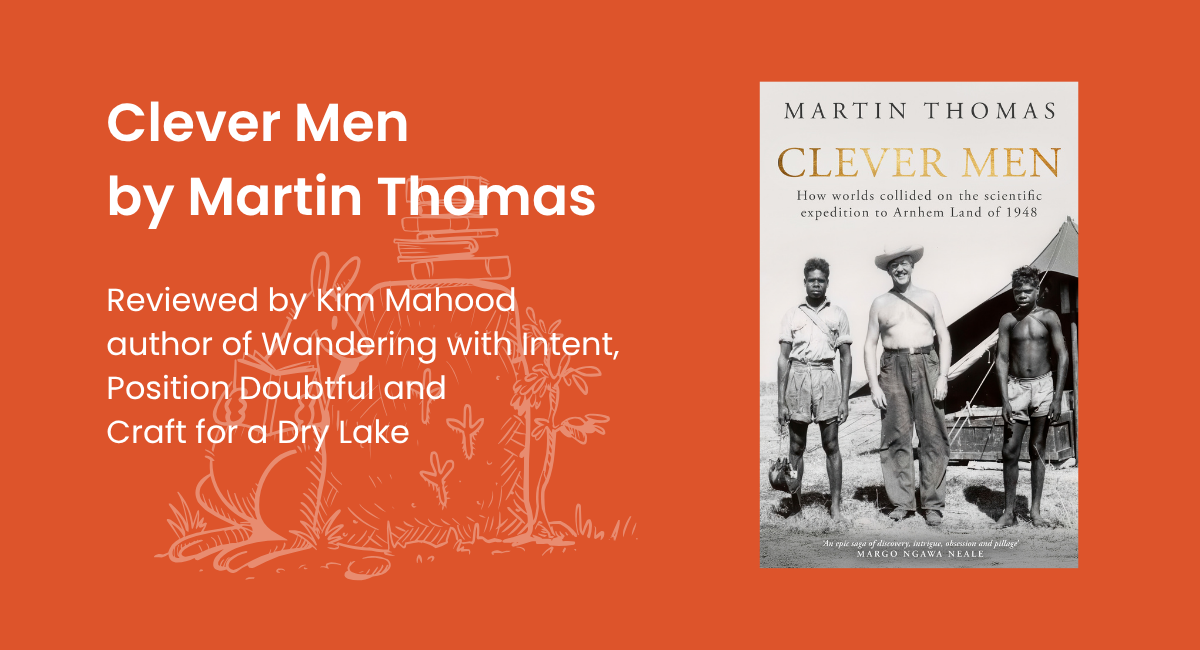
In the coda at the end of Clever Men, Martin Thomas observes that “Large scale expeditions still go forth, but they do not replicate the antics of Monty and his team, with their extravagant melange of soft diplomacy, scientific adventurism, popular appeal, promiscuous collecting, wholesale slaughter of wildlife, and claims about ‘discovering’ a ‘little-known’ Aboriginal world.”
What is Clever Men about?
Who were the Clever Men?
I can’t improve on it as a distillation of the events around which Thomas weaves his narrative, which combines forensic historical scholarship and ripping yarn into an immensely readable account of the 1948 Arnhem Land expedition, led by self-made film-maker and anthropologist Charles Mountford, which saw a cohort of Australian and American scientists travel to Groote Eyelandt, Yirrkala and Gunbalanya in pursuit of Aboriginal culture, information and artefacts.
His curiosity piqued by listening to field sound recordings made by journalist and broadcaster Colin Simpson in 1948, Thomas embarked on a deep dive into the forgotten expedition, unearthing a story of internal conflicts, organisational incompetence, petty rivalries, minor mutinies, gossip and theft. The thread that runs through the book, and which draws the author into the story, is the discovery that the ‘artefacts’ collected by the senior American scientist Frank Setzler were human remains. Thomas becomes part of the project to bring some of those bones back to Australia and oversee their return to the country and families from whom they were stolen.
Clever Men is both a great read and a profound exploration of the attitudes and assumptions at the intersection of ‘science’ and the ‘culture’ it purports to examine, and leaves us questioning ‘who are the clever men?’…
Kim Mahood, author of Wandering with Intent, Craft for a Dry Lake and Position Doubtful